Rotary Rake PTO Gearbox for Hay Tedding and Windrow Raking
Lightweight aluminum right-angle bevel gearbox with 1:1 and 1:1.5 ratio options for 540 RPM tractor PTO. 15-30 HP rated for continuous low-load operation across long hay-making days. Drop-in replacement for Comer, Kuhn, Krone, and other OEM rake gearboxes.
Product Overview
Hay making is a race against the weather. Once grass is cut, every hour it spends lying in the field is an hour closer to rain that can ruin an entire crop. The rotary rake — spinning its tine arms to flip, spread, or gather mown forage into neat windrows — is the machine that determines how quickly and thoroughly your hay dries and how cleanly it feeds into the baler. The PTO gearbox at the heart of that rake is a small, light component that most operators never think about until the day it fails — and that failure always seems to happen on the one sunny afternoon between two weeks of forecast rain.
Unlike the heavy-duty gearboxes used on tillers, cutters, and post hole diggers, a rotary rake PTO gearbox operates under light but continuous load for extended periods — 8 to 12 hours per day during peak hay season, day after day, for weeks on end. The engineering challenge is not brute torque or impact resistance but rather longevity, efficiency, and thermal stability under sustained operation. Our rotary rake gearbox series addresses exactly this with precision spiral bevel gears in a lightweight aluminum alloy housing, high-speed bearings rated for 25,000+ hours, and FKM seals that resist the heat buildup from long continuous runs.
Each unit is a premium aftermarket replacement fully interchangeable with OEM gearboxes from leading hay equipment manufacturers. Browse our complete PTO gearbox catalog for all agricultural implement types.
Disclaimer: Brand names are referenced solely for compatibility identification. Our products are aftermarket replacement parts, not OEM parts. We are not affiliated with any brand mentioned.


Technical Specifications
| Category | Parameter | Specification |
|---|---|---|
| Basic Specs | Gear Ratio Options | 1:1 (direct drive) / 1:1.5 (moderate speed increase) |
| Input Speed | 540 RPM (ISO 500 Type 1) | |
| Output Speed | 540 RPM (at 1:1) / 810 RPM (at 1:1.5) | |
| Rated Power | 15 ~ 30 HP (11 ~ 22 kW) | |
| Continuous Torque (output) | Up to 280 N·m (1:1) / 185 N·m (1:1.5) | |
| Gear System | Gear Type | Spiral Bevel Gear (right-angle 90-degree) |
| Gear Material | 20CrMnTi alloy steel, carburized and quenched | |
| Tooth Hardness | HRC 58-62 (surface) / HRC 33-38 (core) | |
| Gear Precision | DIN Grade 6-7 (low noise for extended operator comfort) | |
| Shaft Config | Input Shaft | 6-spline, 1-3/8 in. (35mm), ISO 500 Type 1 |
| Output Shaft | Keyed or splined, diameter per model (drives central hub or secondary gearbox) | |
| Housing | Material | Aluminum Alloy (lightweight, thermally conductive) |
| Protection | IP54 (dust and splash water) | |
| Surface | Anodized or powder coated (UV and weather resistant) | |
| Seals and Bearings | Oil Seals | Double-lip FKM (Viton) standard — heat resistant for extended continuous runs |
| Bearings | Precision deep groove ball bearings, C3 clearance, 25,000+ hour design life | |
| Weight | Approximately 5-8 kg (depending on model — 50-65% lighter than cast iron equivalent) |
Need a specific output shaft or mounting configuration? Contact our engineers →

How a Rotary Rake PTO Gearbox Works
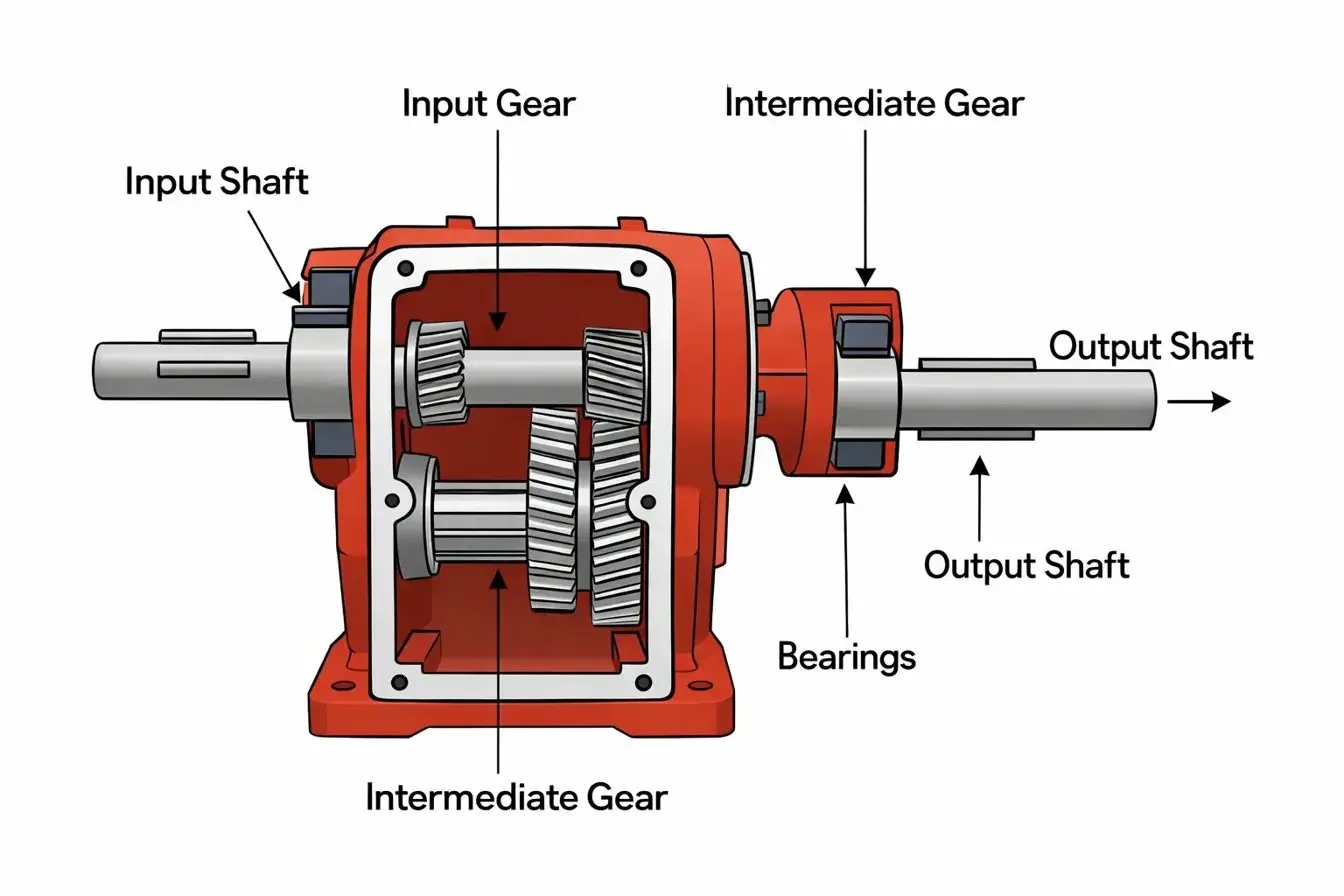
A rotary rake power take-off gearbox is the mechanical link between the tractor PTO and the spinning tine arms that lift, turn, and gather mown forage. It redirects the horizontal PTO rotation 90 degrees downward to spin the central rotor hub from which the tine arms extend. The load profile is fundamentally different from any other agricultural gearbox application: light, smooth, and continuous for hours on end rather than heavy and intermittent.
Power Path — Tractor to Tine Arms:
PTO Input: The tractor PTO delivers 540 RPM through a drive shaft with universal joints. The gearbox input shaft accepts the drive through a standard 6-spline (1-3/8 inch) connection. Because the load on a rake is smooth and predictable — there are no impact events like rock strikes — a shear bolt is typically not required. The absence of an overload protection device means one fewer maintenance item and one fewer potential failure point on an implement designed for trouble-free all-day operation.
90-Degree Bevel Gear Mesh: Inside the aluminum housing, a spiral bevel gear pair redirects rotation from horizontal to vertical. At the 1:1 ratio, the output shaft turns at the same 540 RPM as the input — delivering full speed to the rotor hub for aggressive tedding action that spreads freshly cut forage wide for fast drying. At the 1:1.5 ratio, the output increases to 810 RPM — providing faster tine arm rotation for raking dry forage into tight windrows at higher tractor ground speeds. The spiral tooth geometry is selected for a specific reason in this application: not for load capacity (which is modest) but for low noise generation during the many hours of continuous operation that rake work demands.
Rotor Hub Drive: The vertical output shaft connects to the central rotor hub from which the tine arms radiate outward. Each arm carries spring-loaded tine forks that touch the ground and lift forage as the rotor spins. The connection between the gearbox output shaft and the rotor hub must be absolutely concentric — any runout causes the tine arms to bounce unevenly, creating inconsistent windrows and potentially damaging the expensive cam track mechanism that controls tine angle. Our output shafts are ground to h6 concentricity tolerance to ensure smooth, vibration-free rotor operation.
Why Thermal Management Matters: A rotary rake gearbox running 10 hours per day generates a cumulative internal heat load that tillers and cutters — which run in shorter bursts — never experience. Oil temperature inside the housing can reach 80-90 degrees Celsius during sustained summer operation. This is why we chose aluminum for the housing: its thermal conductivity is roughly 3 times that of cast iron, allowing heat to dissipate through the housing walls to ambient air much faster. Combined with FKM seals that maintain sealing performance up to 200 degrees Celsius, the gearbox stays within safe operating temperature even during the longest midsummer hay-making marathons.

OEM Compatibility — Drop-In Replacement
Our rotary rake agricultural gearbox units match the mounting dimensions, shaft interfaces, and gear ratios of the most widely installed OEM models from European and Asian hay equipment manufacturers.
| OEM Brand | Compatible Model(s) | Ratio | HP | Rake Type |
|---|---|---|---|---|
| Comer Industries | Rake gearbox series | 1:1 / 1:1.5 | 15-30 HP | Single / twin rotor |
| Kuhn | GA series rake gearbox | 1:1 | 15-25 HP | Single rotor |
| Krone | Swadro series gearbox | 1:1 / 1:1.5 | 15-30 HP | Single / twin rotor |
| Pottinger | TOP series rake gearbox | 1:1 | 15-25 HP | Single rotor |
| Claas | Liner series rake gearbox | 1:1 / 1:1.5 | 15-30 HP | Twin / quad rotor |
| Various Korean / Asian OEMs | Custom-matched per drawing | 1:1 to 1:2 | 15-30 HP | All rake types |
Brand names are for cross-reference only. Send us your old gearbox photos or part number and we will confirm the correct replacement within 4 hours.
Core Technical Advantages
Aluminum Housing — Lightweight and Thermally Superior
A rotary rake is a wide, cantilevered implement — some twin-rotor models span 7-10 meters in working position. Every kilogram at the outer ends of that span amplifies the bending load on the frame and the tractor hitch. Our aluminum alloy housing weighs just 5-8 kg — roughly half the weight of an equivalent cast iron gearbox — reducing frame stress and tractor hitch loading on wide-span rake configurations. The aluminum also provides a critical thermal advantage: its thermal conductivity (~205 W/mK) is roughly 3.5 times that of cast iron (~55 W/mK), allowing internal heat to dissipate far more effectively during the 8-12 hour continuous runs that characterize peak hay season. This thermal headroom translates directly into longer oil life, longer seal life, and lower bearing operating temperature — the three factors that determine how many seasons a rake gearbox lasts before needing replacement.
25,000+ Hour Bearing Life
A rake gearbox runs more total hours per season than almost any other agricultural gearbox type. While a mower might run 200-400 hours per year and a post hole digger perhaps 50-100 hours, a busy hay operation can log 600-1,000 hours of rake time in a single season. At that utilization rate, bearing life becomes the primary factor determining gearbox service life. Our precision deep groove ball bearings with C3 internal clearance and polyamide cages are specifically selected for this sustained low-load, moderate-speed duty cycle. The C3 clearance accommodates thermal expansion during long continuous runs without developing the excessive preload that shortens bearing life. The result is a verified design life exceeding 25,000 hours — representing 25-40 seasons of typical commercial hay operation.
FKM Seals Standard — Engineered for Heat, Not Chemistry
On our sprayer gearboxes, we use FKM seals for chemical resistance. On our rake gearboxes, we use FKM for a completely different reason: heat resistance. Standard NBR seals begin to harden and lose elasticity above 100 degrees Celsius. During sustained summer raking — 10 hours under direct sun in 35-degree ambient conditions — the internal oil temperature in a small gearbox housing can reach 85-95 degrees. Add the radiated heat from the seal running surface and the seal lip temperature approaches the NBR limit. FKM maintains its sealing properties up to 200 degrees, providing a comfortable safety margin that prevents the slow seep leaks that develop after NBR seals harden through repeated heat cycling over multiple seasons.
Low Noise at DIN Grade 6-7
An operator raking hay spends 8-12 hours within earshot of the gearbox — far longer continuous exposure than any mowing, tilling, or digging operation. At those durations, even a modest noise difference becomes a significant comfort and health factor. Our DIN Grade 6-7 spiral bevel gears produce measured noise levels below 65 dB at 1 meter under rated load — roughly 4-7 dB quieter than DIN 9-10 gears found in budget alternatives. That 4-7 dB difference represents approximately a halving of perceived loudness, making a tangible difference to operator fatigue during long hay-making days.
Precision Output Shaft Concentricity
The output shaft of a rake gearbox directly drives the rotor hub. Any runout (eccentricity) in the output shaft translates into a wobbling rotor that causes tine arms to bounce, creating uneven windrows and accelerating wear on the expensive cam track mechanism that controls tine pitch angle. Our output shafts are precision ground to h6 concentricity tolerance — tighter than the h7 tolerance typical of mower and tiller gearbox output shafts — because the rake application demands smoother rotation for consistent forage handling. This tighter tolerance is achievable in part because the rake gearbox experiences no impact loads that would distort the shaft over time.
Transmission Efficiency Above 97%
At 15-30 HP, the absolute power transmitted through a rake gearbox is modest. But when that gearbox runs for 600-1,000 hours per season, even small efficiency losses compound into measurable fuel waste and unnecessary heat generation. Our lapped spiral bevel gear pairs achieve transmission efficiency above 97% at rated load — 2-4% better than typical budget units with DIN 9-10 gears. On a 20 HP gearbox running 800 hours per season, that 2-4% efficiency difference translates to approximately 40-80 liters of fuel saved per season and proportionally less internal heat that the bearings and seals must endure.

Manufacturing Process and Quality Assurance
Every rotary rake tractor PTO gearbox is manufactured in our ISO 9001:2015 certified facility. The key quality target for rake gearboxes is sustained precision over extreme accumulated operating hours — which means tighter machining tolerances and more rigorous run-in testing than impact-rated gearbox types.
Material Verification
OES spectral analysis for gear alloy. Aluminum alloy verified to specification. Hardness and tensile testing on all incoming material lots.
Gear Cutting and Lapping
Spiral bevel pairs cut on Gleason-type machines. Each set lapped for 85%+ contact pattern — tighter than the 80% standard for mower gearboxes — to minimize noise during sustained operation.
Heat Treatment
Atmosphere-controlled carburizing. HRC 58-62 surface, HRC 33-38 core. Focus on surface finish after treatment — grinding to restore DIN 6 accuracy for low-noise high-efficiency meshing.
Aluminum Housing CNC
Bearing bores machined to h6. Output shaft bore concentricity verified by dial indicator. Anodizing or powder coating for outdoor corrosion protection.
100% Extended Run-In Test
60-minute no-load run — double the 30-minute standard for mower gearboxes — to verify thermal stability and break in the gear mesh pattern. Noise below 65 dB at 1m. Temperature rise monitored. Individual report archived.
Packaging
VCI anti-corrosion wrap. Carton box packaging (aluminum housing is lightweight and less fragile than cast iron). Test report and manual included. FOB Incheon/Busan.
Typical Applications for Rotary Rake PTO Gearboxes
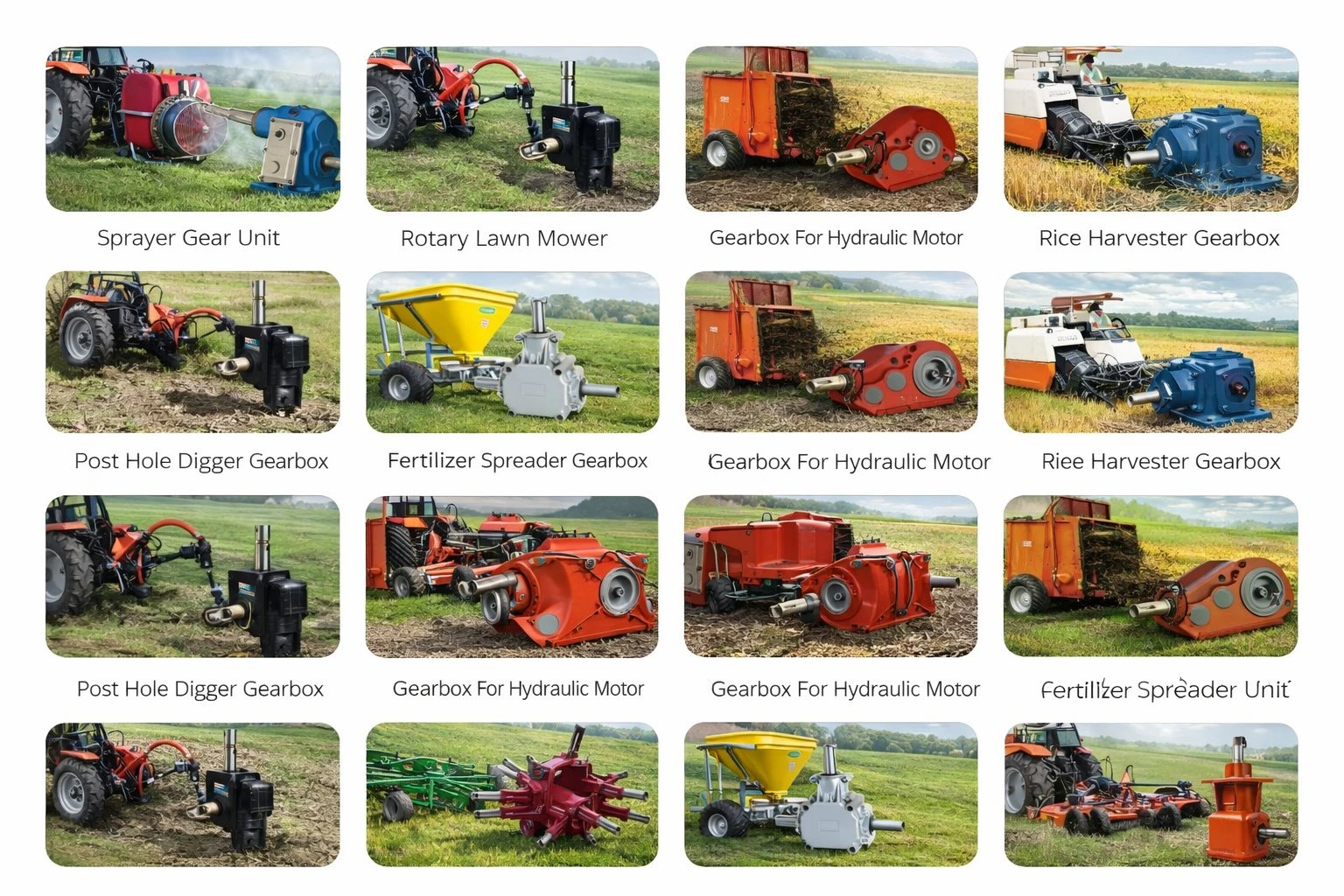
The rotary rake gearbox operates in the most time-sensitive segment of any farming operation: the window between mowing and baling when weather can turn a valuable hay crop into composting mulch. Every hour of reliable gearbox operation during that window has a direct dollar value measured in saved forage quality. Learn more about PTO gearbox applications across the agricultural industry.
Hay Tedding — Spreading Cut Forage to Dry
Immediately after mowing, the rotary rake operates in tedding mode — spinning its tine arms to lift and scatter the mown grass evenly across the field surface for maximum sun and air exposure. The 1:1 gearbox ratio at 540 RPM provides the aggressive tine action needed to fluff and spread heavy, wet, freshly-cut forage. Tedding typically runs for 4-6 continuous hours per pass across the field, representing the highest sustained load event for the gearbox during the hay-making cycle.
Windrow Raking — Gathering Dry Forage for Baling
Once the forage has dried to target moisture (typically 15-18% for dry hay), the rake switches to raking mode — gathering the scattered material into neat windrows that the baler can pick up efficiently. The 1:1.5 ratio gearbox (810 RPM output) allows faster raking at higher tractor ground speeds because the tine arms complete their gathering motion more quickly at each ground contact point. This higher speed is possible because dry forage is lighter and offers less resistance than wet material.
Silage Merging — Combining Windrows
Twin-rotor and quad-rotor rakes are used to merge two or more narrow mower swaths into a single wide windrow for high-capacity forage harvesters. These larger rakes use multiple gearboxes — one per rotor — and run at high tractor speeds (12-18 km/h) to keep up with the harvester’s throughput demand. The 1:1.5 ratio gearbox is standard for merging applications where speed is prioritized over gentle forage handling.
Dairy Farm Pasture Management
Dairy operations in Korea, Japan, and Hokkaido that produce their own silage and hay run rakes almost daily during the growing season (May-October). This extreme utilization — 600-1,000 hours per season — is the most demanding endurance test for any rake gearbox. Bearing life, seal integrity, and oil stability over sustained continuous operation are the decisive quality factors for these high-hour dairy farm applications.
Straw Collection After Grain Harvest
After rice or wheat harvest, the remaining straw is raked into windrows for baling and removal or for incorporation back into the field. Straw raking is lighter duty than hay tedding but occurs during hot, dusty harvest-season conditions that test the gearbox sealing system. The IP54-rated double-lip FKM seals keep fine straw dust and harvest debris out of the oil during these peak-exposure periods.
Contract Hay-Making Operations
Professional hay contractors running multiple rakes across client farms accumulate the highest annual hours of any rake operation. Their gearboxes face not only sustained running time but also constant transport vibration between farm locations. The lightweight aluminum housing reduces transport stress on the rake frame, while the 25,000-hour bearing specification ensures multiple seasons of contractor-intensity use before replacement is needed.
Budget Gearbox vs Our Premium Rotary Rake Gearbox
| Feature | Budget Alternative | Our Premium Unit |
|---|---|---|
| Housing Material | Cast iron (heavy, poor heat dissipation) | Aluminum alloy (50-65% lighter, 3.5x thermal conductivity) |
| Oil Seals | NBR (hardens after 2-3 seasons of heat cycling) | FKM standard (200 C rating, 8-10+ seasons) |
| Bearing Design Life | 10,000-12,000 hours (5-10 seasons) | 25,000+ hours (25-40 seasons) |
| Gear Noise (at 1m) | 69-72 dB (DIN 9-10) | Below 65 dB (DIN 6-7, lapped pairs) |
| Gear Contact Pattern | 70-75% (random paired) | 85%+ (individually lapped matched pairs) |
| Transmission Efficiency | 93-95% | Above 97% (saves 40-80 L fuel per season) |
| Output Shaft Concentricity | h7 (adequate for mowers) | h6 (precision for rotor hub smoothness) |
| Run-In Test Duration | 30 minutes (if any) | 60 minutes with thermal monitoring |
| Warranty | 3-6 months | 12 months |
Customer Success Stories
🇰🇷 Chungcheongbuk-do, South Korea — Dairy Cooperative
A 28-farm dairy cooperative producing its own hay and silage was replacing 5-6 rake gearboxes per season across their fleet of 14 single-rotor rakes. The primary failure mode was oil seal hardening after 400-500 hours of continuous summer operation — the cast iron housings retained heat and cooked the NBR seals from the inside. The cooperative’s equipment manager contacted us in January 2025 after reading our technical article on PTO gearbox thermal management.
Result: We supplied 14 aluminum-housing gearboxes with FKM seals. Internal oil temperature during sustained operation dropped by 12-15 degrees compared to the cast iron units, measured by the cooperative’s maintenance team using an infrared thermometer. After the complete 2025 hay season (May-October, approximately 750 hours per unit), zero seal leaks were detected. The cooperative eliminated their annual 5-6 gearbox replacement budget entirely.
“We could actually feel the temperature difference on the housing with our hands. The aluminum units run noticeably cooler than the old cast iron ones. That 12-degree drop saved every seal in the fleet.” — Mr. Ryu, Equipment Manager
🇯🇵 Hokkaido, Japan — Hay Contractor
A professional hay contractor in Tokachi running 6 twin-rotor rakes (12 gearboxes total) was logging over 900 hours per gearbox per season — among the highest utilization rates in the industry. Their European OEM gearboxes were developing bearing noise at 8,000-10,000 cumulative hours (approximately 10 seasons), which was acceptable but created an unpredictable replacement schedule. The contractor wanted longer intervals between gearbox replacements to reduce maintenance planning complexity across a large fleet.
Result: Our 25,000-hour rated bearings extended the expected replacement interval from approximately 10 seasons to over 25 seasons — effectively making the gearbox a lifetime component that outlasts the rake frame itself. After 2 full seasons (1,800 cumulative hours), bearing vibration measurements on all 12 units show zero detectable wear progression. The contractor plans to standardize on our gearboxes for all future rake purchases and replacements.
“At 900 hours per season, I need components I can forget about. After two seasons and 1,800 hours, these gearboxes are still measuring like new. That is what I call reliability.” — Mr. Takeda, Owner-Operator
🇦🇺 Gippsland, Victoria, Australia — Dairy Farm
A 600-cow dairy farm producing 4,000 round bales of hay per season was experiencing gearbox noise complaints from the tractor operator — the operator was spending 8-10 hours per day on the rake during the December-February peak hay window, and the budget gearbox whine was contributing to fatigue and headache by late afternoon. The farm manager asked his equipment dealer whether a quieter replacement existed.
Result: We supplied 2 gearboxes (one per rake) through the dealer. The operator reported an immediately noticeable noise reduction — measured at 6 dB lower than the previous units. The farm manager noted that afternoon productivity improved because the operator was less fatigued and took fewer breaks. A small component change with an outsized impact on daily output during the most time-critical weeks of the farming year.
“My operator told me he could actually hear his radio again with the new gearboxes fitted. He was not joking — the old ones were that loud. He rakes an extra hour per day now because he is not worn out by 4 PM.” — Mr. O’Brien, Farm Manager
🇳🇿 Canterbury, New Zealand — Hay Equipment OEM
A New Zealand manufacturer of single-rotor and twin-rotor rakes was sourcing gearboxes from an Italian supplier at EUR 95 per unit with 10-week lead times. Seasonal demand spikes required them to hold 6 months of inventory to avoid production delays — tying up significant working capital in a small company. They contacted us after a trade show introduction in March 2024.
Result: Our gearboxes matched the Italian specifications at a 25% lower unit cost with delivery to Auckland reduced from 10 weeks to 18 working days. The shorter lead time allowed the manufacturer to cut their gearbox inventory holding from 6 months to 6 weeks — freeing up NZD 120,000 in working capital. Quality has been verified through 18 months of field service across 320 rake installations with zero warranty claims.
“The lead time improvement is worth more than the price saving. Not having NZD 120,000 worth of gearboxes sitting on the shelf waiting for hay season transformed our cash flow.” — Mr. Williams, Managing Director
Frequently Asked Questions
What is the difference between 1:1 and 1:1.5 ratio for a rake gearbox?
The 1:1 ratio delivers 540 RPM directly to the rotor — best for tedding (spreading) heavy wet forage where aggressive tine action at moderate speed is needed. The 1:1.5 ratio increases the output to 810 RPM — better for raking and merging dry forage at higher tractor ground speeds where faster tine rotation is needed to complete the gathering motion before each tine arm lifts off the ground. Many operators use 1:1 for tedding passes and 1:1.5 for raking passes, swapping the gearbox between operations if they run both modes on the same machine.
Why does this gearbox use aluminum instead of cast iron?
Two reasons: weight and thermal management. A rake gearbox operates under light load — 15-30 HP — so it does not need the extreme structural strength of cast iron required by post hole diggers or heavy-duty cutters. The aluminum housing saves 50-65% weight, reducing stress on wide-span rake frames and tractor hitches. The thermal benefit is equally important: aluminum dissipates heat 3.5 times faster than cast iron, keeping internal oil and seal temperatures 10-15 degrees cooler during the 8-12 hour continuous runs that define peak hay season. Lower temperatures mean longer seal life, longer oil life, and longer bearing life.
How often should I change the oil?
Use 75W-90 GL-5 synthetic gear oil for best thermal stability during long continuous runs. Check oil level weekly during hay season. Change oil at 400 hours or once per season, whichever comes first. For contractors logging 800+ hours per season, consider a mid-season oil change at 400 hours. Synthetic oil is recommended over mineral oil because it maintains viscosity more consistently across the wide temperature range between cool morning startups and hot afternoon sustained operation.
Does this gearbox need a shear bolt or slip clutch?
Not typically. Rotary rakes operate under smooth, light, predictable loads with no impact events. The tine arms are spring-loaded to flex over obstacles, and the forage itself offers minimal resistance. There is no mechanism in normal rake operation that can generate the sudden torque spikes that require shear bolt or slip clutch protection. However, if your rake has a design feature that could cause a sudden jam — such as an under-mounted conveyor belt or a pickup mechanism — a shear bolt option is available on request.
Will this gearbox fit my Kuhn, Krone, or Claas rake?
We manufacture compatible replacement gearboxes for the most common models from Kuhn (GA series), Krone (Swadro series), Claas (Liner series), Pottinger (TOP series), and Comer Industries. However, rake gearbox mounting configurations vary more between brands than mower or cutter gearboxes do. Please send us your rake brand, model, and year — or a photo of the existing gearbox with visible mounting points — and we will confirm compatibility. Email: [email protected]
Can I use a cast iron mower gearbox on my rake to save cost?
Only if the mounting dimensions, shaft configuration, and gear ratio are identical — which they sometimes are between rakes and mowers from the same manufacturer. However, you will be adding unnecessary weight to a wide-span implement and losing the thermal advantage that matters most in the sustained continuous operation that rakes demand. The cast iron housing also lacks the corrosion resistance of anodized aluminum in the outdoor storage conditions between hay seasons. We recommend the purpose-built aluminum rake gearbox for best results and longest service life.
What is the minimum order quantity and lead time?
Standard models: 10 units minimum, 15-20 working days. Custom configurations: 50 units minimum, 30-45 working days. Sample orders of 1-3 units available for evaluation. Volume pricing at 100+ and 500+ annual quantities. We recommend placing orders by February-March to ensure delivery before the Northern Hemisphere hay season begins in May.
What warranty do you provide?
12 months from date of shipment covering material defects and manufacturing workmanship. Does not cover damage from exceeding the 30 HP rating, improper installation, or failure to maintain oil. Warranty claims handled by express shipping free replacement units. Contact [email protected] with serial number and photos.
Get Your Rotary Rake PTO Gearbox Quote
Tell us your rake brand, model, and whether you need a tedding (1:1) or raking (1:1.5) ratio — or send photos of your existing gearbox — and we will confirm the match and provide a competitive quotation within 4 business hours. Email: [email protected]
Editor: Cxm